

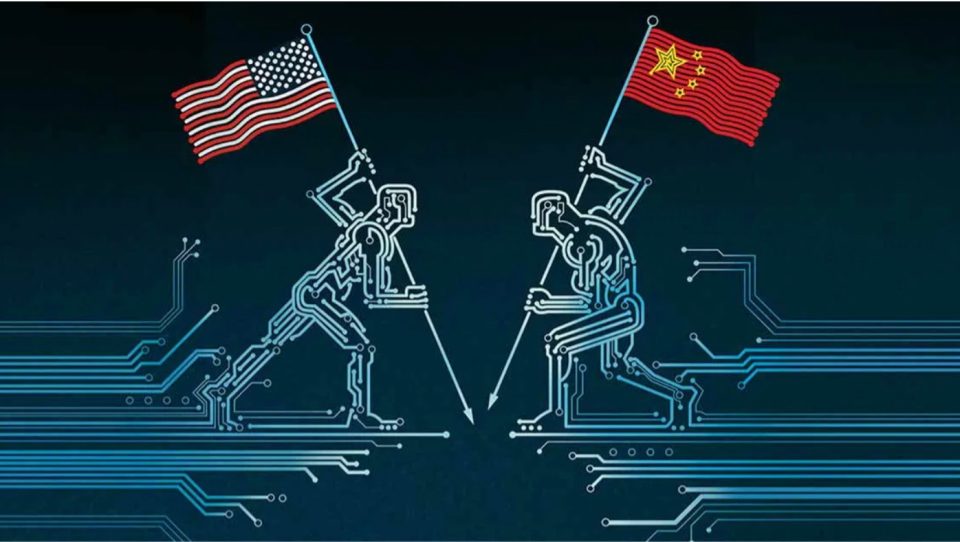
As debate over artificial intelligence intensifies, China has rapidly narrowed its lead gap with the United States, with several Chinese models and startups now cited among the most capable systems globally.
Chinese companies and startups have rolled out strong frontier models this year. Beijing-based Moonshot AI released Kimi K3 and briefly ranked it third globally in model intelligence in July, shortly after its release, behind Anthropic’s Claude Fable 5 and OpenAI’s GPT-5.6 Sol, according to benchmarking platform Artificial Analysis; Kimi K3 now ranks ninth. Startup DeepSeek’s R1 model, released in January 2025, proved cost-effective compared with similar U.S. models and in April the company previewed a more powerful V4 with claimed gains in knowledge, reasoning and “agentic” capabilities. Z.ai’s GLM-5.2, rolled out in June, drew comparisons with advanced Anthropic and OpenAI models; Z.ai followed with GLM-5.3 in August, improving coding and agentic features and rising in global rankings. In July, Alibaba previewed Qwen3.8-Max, which it described as the most powerful in its Qwen series and a challenger to Anthropic’s Claude Fable and OpenAI’s GPT.
AI competition and expert views
Observers and recent analyses, including a report by the Stanford Institute for Human-Centered Artificial Intelligence, say China has emerged as an AI counterweight to the U.S. and appears this year to be erasing the U.S. lead. “The gap between U.S. and Chinese models is narrow and fragile,” said Samm Sacks, a senior fellow at the Johns Hopkins School of Advanced International Studies’ Institute for America, China, and the Future of Global Affairs.
The U.S. has outpaced China in areas such as model capabilities, research and citations, and has blocked Chinese access to some advanced technologies, including cutting-edge chips and the machines that make them. Still, analysts say Chinese developers have been rapidly closing the capability gap.
Security and governance concerns in China
Chinese officials have voiced concerns about AI’s risks to national security and governance. Chen Yixin, head of China’s state security ministry, wrote that artificial intelligence could threaten political, institutional and ideological security if used by “hostile forces and individuals with ulterior motives.” He warned that AI-generated deepfake audio and video could produce “political rumors” at scale and cited the capabilities of Anthropic’s Claude and OpenAI’s GPT as examples of tools that could be used to identify and “weaponize” cybersecurity vulnerabilities, enabling some actors to “execute complex hacking tasks.”
Top Chinese leaders have urged accelerated AI development and technological self-reliance, while also noting the need to control risks and to pursue a global framework for AI governance.
U.S. allegations of capability extraction and distillation
U.S. officials have stressed the strategic importance of maintaining an AI edge. “Whoever wins AI, wins,” U.S. President Donald Trump told reporters. U.S. agencies and companies have accused some Chinese developers of using “industrial-scale distillation,” a process in which models are trained to copy or imitate capabilities of more powerful systems. Anthropic has accused Chinese startups DeepSeek and Moonshot of routing a number of their user requests to its Claude model.
In a Sept. 8 report, the FBI, the National Security Agency and the Cybersecurity and Infrastructure Security Agency said Chinese AI developers extracted capabilities from some of the most advanced U.S. models in “aggressive, malicious, and targeted distillation activities.” Beijing rejected those claims, saying distillation is commonly used by many AI companies, asking the United States to refrain from making “unfounded accusations,” and accusing the U.S. of pursuing a “monopoly of the AI industry.”
Analysts note that distillation is a standard industry technique but that U.S. agencies have alleged unauthorized access and other methods were used to extract restricted capabilities from frontier models. Some observers say the situation highlights new concerns about restricting not only inputs to frontier AI—such as chips—but also potential outputs and derived capabilities.
The debate over AI’s risks and governance takes on added urgency ahead of Chinese President Xi Jinping’s expected visit to Washington this month to meet U.S. President Donald Trump, with experts saying the future of AI will depend in part on what both countries do and do not do.
