

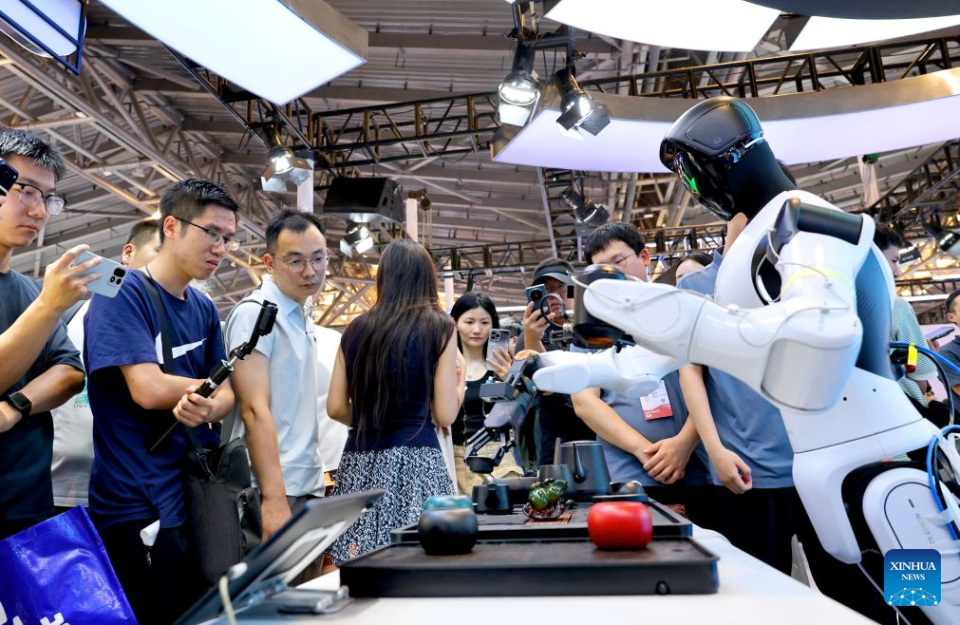
As China pushes artificial intelligence beyond research labs and megacities, coordinated policy and industry efforts are translating cutting‑edge systems into everyday services for farmers, doctors and small businesses, officials and executives said at the 2026 World AI Conference in Shanghai.
## China AI on the road: map‑free autonomous deliveries
On the outskirts of Wuhan, a small autonomous delivery van developed by Zelostech has begun changing how perishable goods reach market. The vehicle, which uses real‑time sensing and multi‑sensor fusion rather than costly high‑definition maps, can navigate country roads and make multiple same‑day runs. Farmer Zhang Shuwang said the robovan increased his peak morning trips from one to as many as three or four, raising his annual income by “at least 30 to 40 percent.”
Zelostech announced mass production of its L4 map‑free driving solution at the conference, claiming it is the world’s first company to reach that milestone. By removing the need for HD maps, the system cuts deployment time from roughly a month to under a day, the company said — a change that lowers costs and extends last‑mile logistics to remote regions where traditional mapping is impractical.
“We want to use AI to make cities smarter and more people‑centered,” said Kong Qi, Zelostech’s CEO, highlighting what he described as a shared effort between government and enterprise to widen access to e‑commerce and urban services.
## Health, education and services: vertical AI for local needs
The same pattern — specialized AI tools bringing expertise to underserved areas — is visible in health and other sectors. In a remote clinic on the Loess Plateau, village doctor Li Huayu uses an AI medical assistant from Xunfei Healthcare that pulls from more than 13,000 clinical guidelines, 1,400 standard clinical pathways and a database covering over 6,000 diseases. The system suggests diagnoses and treatments, checks prescriptions against patient histories and flags symptoms needing further checks.
Xunfei said its platform has rolled out to 811 county‑level regions, supporting more than 250,000 primary‑care doctors and issuing over 1.2 billion diagnostic recommendations. The company is also piloting AI programs for chronic disease management — including diabetes — to shift emphasis toward prevention, according to Tao Xiaodong, president of Xunfei Healthcare.
Beyond health, vertical AI models are being applied to education, finance and law: tools to help high‑school graduates choose university majors, platforms delivering cash‑flow analytics to small merchants, and government‑subsidized AI contract review services for businesses in Chongqing’s Beibei District. Those applications demonstrate how tailored models can convert scarce expertise into widely usable services.
## National
