

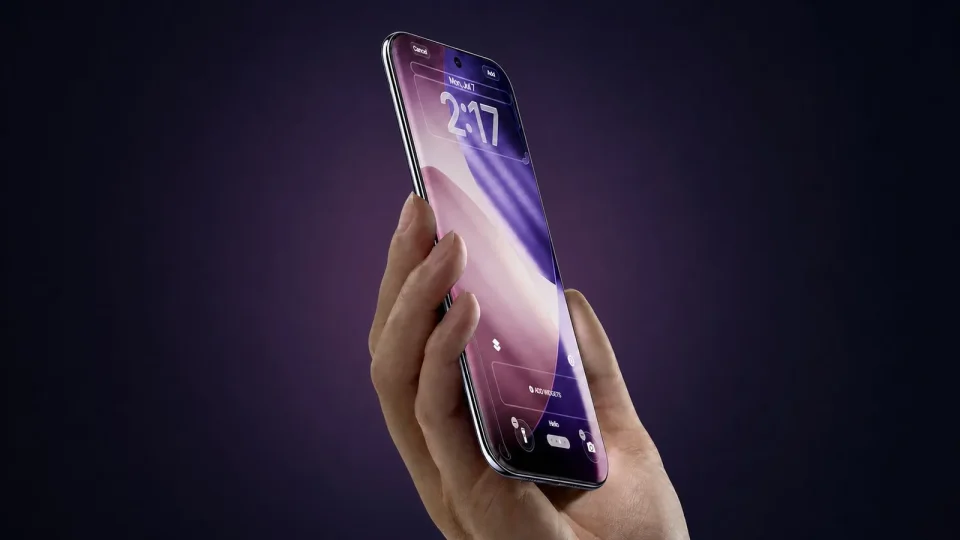
UBI Research reports that Apple could adopt Color Filter on Encapsulation (CoE) — a polarizer-free OLED approach — for its 2029 “Pro” iPhones.
CoE technology and how it works
CoE removes the conventional polarizer from the OLED panel and places a color filter directly on top of the panel’s encapsulation layer. A polarizer typically suppresses reflections from ambient light but also absorbs a significant portion of the display’s emitted light. Removing it lets more light pass through, which can enable higher brightness at the same power draw or comparable brightness with lower power consumption. Eliminating the separate polarizer layer can also make the display assembly thinner, freeing internal space for components such as the battery and cameras.
Samsung first commercialized the technique under the Eco² OLED name with the Galaxy Z Fold3. According to Samsung’s internal testing, that implementation improved light transmission by 33% and reduced power consumption by up to 25% compared with an OLED panel using a traditional polarizer.
Challenges, timing and Apple’s rollout plans
CoE presents technical challenges because, without a polarizer, manufacturers must control external reflections through a mix of color filters, black pixel-defining layers, low-reflection coatings and other optical measures. UBI Research says the difficulty of maintaining outdoor visibility, viewing angles, contrast and color accuracy may explain why Apple would wait until 2029 to introduce the technology across its high-volume conventional iPhone Pro models.
Prior to the unveiling of the iPhone Duo, reports indicated the device’s Samsung-supplied folding OLED would use CoE. Apple has not disclosed the panel’s internal construction; UBI Research views the foldable device as a potential first step toward broader use of polarizer-free OLED displays across the iPhone Pro lineup.
UBI Research estimates annual panel demand for the two Pro models could remain between 90 million and 100 million units, making the proposed transition far larger in scale than CoE’s current use in foldable devices. Samsung Display and LG Display are expected to lead initial supply, while BOE could compete for orders if it can meet Apple’s requirements.
