

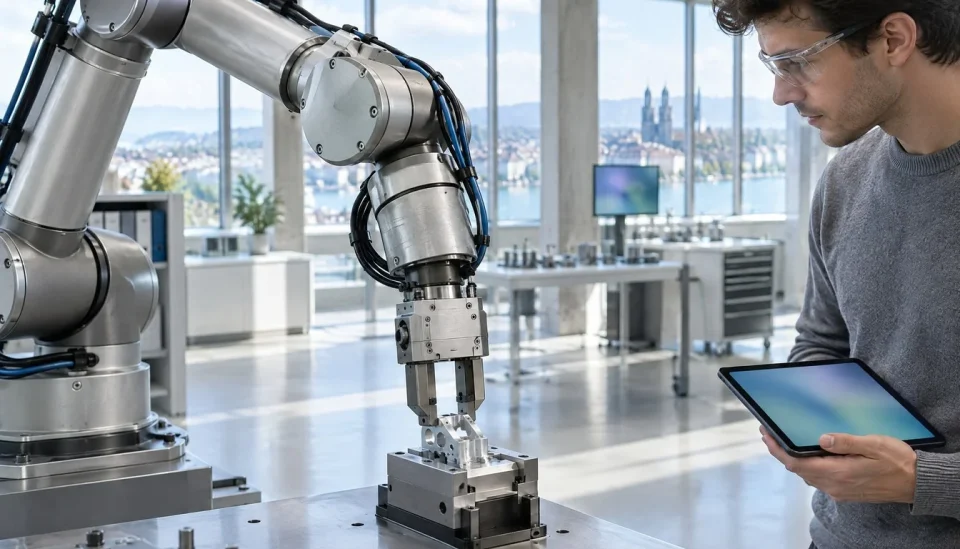
Enact Intelligence, a Zurich-based startup, emerged from stealth on October 22, 2026, announcing a $30 million pre-seed round to develop robots that sense force and touch through their own motor actuators rather than relying solely on vision.
What Enact Intelligence announced
Enact disclosed a $30 million pre-seed raise and said it will use the funds to expand the team, accelerate hardware and R&D, and pursue initial deployments with industrial partners. Coverage from multiple outlets reports euro conversions of roughly €27 million, with one report listing €26.68 million. The company also aims to grow headcount fivefold by the end of 2027. The announcement does not name customers, give a product launch date, or list pricing.
How Enact’s force‑sensing approach works
Enact says its robots measure force inside the motors that move each joint, making every joint a sensor. CEO Manuel Yves Galliker described the idea as follows: “In particular, our robots sense force and touch through their own actuators, so they feel what’s happening in real time, and learn more data-efficiently while simultaneously pushing reliability and performance.” The company has not published engineering details or public benchmarks for these claims.
In general terms, a motor under load exhibits different electrical and mechanical behavior than one moving freely, and engineers can estimate contact forces from those signals. Enact’s stated goal is whole‑body awareness via actuator-based sensing instead of relying on cameras or a single wrist force sensor. That design choice would add a continuous force input at every joint for control and learning systems, while placing demands on signal quality and integration between sensors, actuators and software.
Where the money will go
Enact named three uses for the round: hiring, hardware and R&D acceleration, and pilot deployments with industrial partners. The hardware focus reflects the higher costs of actuators, test rigs and physical iteration compared with software-only startups. The fivefold hiring target by the end of 2027 is a concrete milestone outside of product deliveries.
Backers and notable angels
Reports list venture investors redalpine, Notion Capital and firstminute capital participating in the round; one report describes the round as led by redalpine. Named angel investors include Arthur Mensch, Yann LeCun and Andrew Lonsberry. A separate outlet also lists Thomas Wolf as an additional investor; that detail did not appear across the wider set of reports.
How the pitch fits the broader field
Enact positions itself against camera-first robotics stacks by emphasizing tactile and proprioceptive signals. The company says it will build on existing models rather than collecting all data from scratch: “We can build on top of existing models, like video models, and adapt them to output robot actions for interacting with the real world,” Galliker said. The firm frames the current moment in robotics as one where large perception and reasoning models reduce some barriers, while physical interaction data remains the bottleneck.
This pre-seed round joins other large early hardware bets in physical AI; for comparison, one competitor raised a $90 million seed for any-robot AI model work. Enact has not published head-to-head results against rivals, so claimed advantages remain unvalidated.
Key risks and unconfirmed points
The company faces at least four practical risks it must address to reach industrial deployments: signal quality in noisy, hot or vibrating environments; calibration and long-term sensor trustworthiness across many joints; the need for sufficient real contact data to train and validate policies; and the slow, demanding qualification cycles of industrial customers. Public reporting contains some unverified items: claims that this is among the largest European or the largest Swiss pre-seed rounds are not independently confirmed in the reviewed coverage, and the listing of Thomas Wolf as an investor appears in a single outlet.
What to watch next
Measurable next milestones include hiring progress toward the fivefold headcount goal, published pilot announcements with industrial partners, and any benchmarks or comparisons that demonstrate the company’s data-efficiency and reliability claims. Those steps will be key to testing whether actuator‑based force sensing delivers the practical benefits Enact describes.
Enact’s round is a signal of investor appetite for hardware‑centered physical AI in Europe, but the company still must translate funding into reliable hardware, tested software stacks, and customer pilots before its claims can be verified.
