

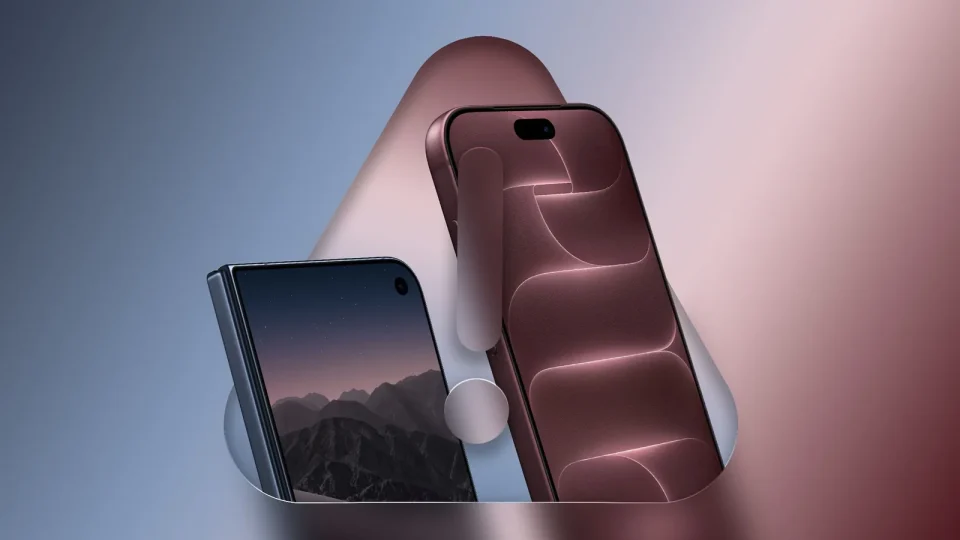
Apple’s $1,999 iPhone Duo asks buyers to pay hundreds more for a folding screen while accepting nearly 40 compromises versus the iPhone 18 Pro and iPhone 18 Pro Max across camera capabilities, everyday usability, and ownership costs. Its defining hardware trade is a 5.4-inch outer display that opens to a 7.6-inch inner display, enabling side-by-side apps and more room for reading and viewing, but requiring buyers to weigh many functional and financial differences.
General compromises for the iPhone Duo
The iPhone Duo replaces Face ID with Touch ID in the side button, altering how users unlock the phone and authenticate purchases and apps. It omits the customizable Action button used for Silent mode, flashlight, Focus modes and Shortcuts; Camera Control remains available but there is no dedicated physical mute control. Apple lists MagSafe cases and wireless chargers as compatible, but omits the MagSafe wallet compatibility shown for the Pro models, citing the Duo’s shape. The Duo is eSIM-only worldwide, while Pro models sold in markets such as the UK and Australia retain a nano-SIM slot.
The Duo’s outer display is 5.4 inches versus 6.3 inches on the iPhone 18 Pro and 6.9 inches on the Pro Max; accessing the larger 7.6-inch screen requires unfolding the device. Its inner display has 430 pixels per inch compared with 460 ppi on both Pro models; the outer display retains 460 ppi. The folding screen shows a crease visible in some lighting despite Apple’s efforts; Pro models use a conventional crease-free display.
Display maintenance differs: the outer screen uses Ceramic Shield 2, while the inner screen uses a polymer cover layer that is replaceable. In the U.S., cover-layer replacement is estimated at $49 without AppleCare+ or $19 with coverage, introducing a service item absent from the Pro models.
Physically, the Duo is shorter when closed but wider and thicker: 84.1 mm wide and 11.3 mm thick versus widths of 71.9 mm and 78 mm and a thickness of 8.75 mm on the Pro models. At 254 grams it is 43 grams heavier than the Pro and 5 grams heavier than the Pro Max. The Duo is rated for up to 24 hours of typical use, matching the smaller Pro but short of the Pro Max’s 30 hours.
Video battery figures vary by display: with the inner screen the Duo is rated for up to 31 hours of video playback and 26 hours of streaming, compared with 36 and 33 hours on the iPhone 18 Pro and 45 and 40 hours on the Pro Max. Using the outer display improves those Duo figures to 44 and 37 hours, exceeding the smaller Pro’s ratings.
Wired charging reaches up to 50 percent in around 20 minutes on the Duo, compared with around 15 minutes on both Pro models. Apple quotes up to 35 percent better sustained performance than the iPhone 17 Pro for the Duo, compared with up to 40 percent for the iPhone 18 Pro models.
Color and materials differ: the Duo comes in Night Sky and Star White; the Pro models offer Black, Silver, Glacier and Burgundy. The Duo contains 35 percent recycled content versus 40 percent on the Pro models.
Price and ownership costs diverge. At equivalent storage capacities the Duo costs $800 more than the iPhone 18 Pro and $700 more than the Pro Max; the Duo’s $1,999 starting price buys 256 GB while a 1 TB Pro Max costs $1,899. In the U.S., AppleCare+ with Theft and Loss is $19.99 per month or $199.99 annually for the Duo, compared with $14.99 per month or $149.99 annually for either Pro model.
Under U.S. AppleCare coverage, accidental damage to the Duo’s inner display carries a $99 service fee versus $29 for screen-only damage on the Pro models; the Duo’s outer-display damage fee is $29. Apple’s U.S. out-of-warranty estimates list $999 for inner-display damage on the Duo, compared with screen-repair fees of $329 for the Pro and $379 for the Pro Max. Other damage is estimated at $1,499 for the Duo, compared with $849 and $899 respectively for the Pro and Pro Max. Back-glass repair is estimated at $199 for the Duo versus $159 for either Pro model. The U.S. out-of-warranty battery service fee is $229 for the Duo, compared with $129 for either Pro model.
Camera and capture compromises
The Duo lacks the Pro models’ dedicated Telephoto camera: no 48-megapixel 4x Telephoto with tetraprism design and 3D sensor-shift stabilization, and no 12-megapixel optical-quality 8x crop. The Duo’s longest optical-quality zoom is a 2x crop from the Main camera; digital photo zoom tops out at 10x rather than 40x, and video zoom reaches 6x rather than 24x.
The Duo’s Main camera has a fixed f/1.6 aperture; the Pro models offer variable apertures of f/1.48, f/1.8, f/2.8 and f/4.0. The Duo uses sensor-shift optical image stabilization and Hybrid Focus Pixels, compared with second-generation sensor-shift stabilization and 100 percent Focus Pixels on the Pro models. Main-camera framing is slightly tighter on the Duo at a 26 mm equivalent focal length versus 24 mm on the Pro models; its 2x crop is 52 mm rather than 48 mm.
The Duo omits a LiDAR Scanner and uses a standard True Tone flash rather than the Pro models’ adaptive True Tone flash. It does not include the Pro models’ full suite of manual Pro controls for aperture, shutter speed, white balance and histogram, and it does not offer ProRAW photography, including on the front camera. The Duo cannot capture Apple Reference Images used to help establish whether a photo has been altered.
Spatial photo and spatial video capture are not available on the Duo; both Pro models support spatial video recording at 1080p at 30 fps. ProRes and ProRes RAW recording are unavailable in the Duo’s native camera feature set, including for front-facing capture; Pro models support ProRes recording up to 4K at 120 fps from the rear camera and 4K at 60 fps from the front camera with external recording. Apple Log 2 and ACES support for rear and front-camera recording are omitted, and Genlock support for synchronizing video capture with other cameras is not present on the Duo.
Apple specifies a studio-quality four-mic array for the Pro models but does not list the same specification for the Duo. The Duo still supports Spatial Audio recording, wind noise reduction and Audio Mix. The outer Center Stage camera on the Duo is 12 megapixels with an f/2.2 aperture, compared with 18 megapixels and f/1.9 on the Pro models. The inner under-display camera is limited to 1080p video at 30 or 60 fps and lacks Night mode, portrait photography and Photographic Styles; the Pro models’ front camera supports 4K Dolby Vision recording and those photography features.
Are the compromises worth it?
The iPhone Duo can justify these compromises if its inner display meaningfully improves tasks you regularly do on a phone: reading long articles, reviewing documents, comparing information in two apps, editing photos, or watching video could all be more comfortable on the 7.6-inch screen. Prospective buyers should assess how often they would unfold the device and what they would use the larger display for, since regular use strengthens the case for the foldable while occasional use may favor an iPad, Mac or a Pro model.
Hands-on testing is recommended and should include using the phone closed. Check comfort with the Duo’s width, thickness, weight, outer display and Touch ID button, then unfold it and try the activities you expect to benefit from the larger screen. The device needs to suit both the quick interactions that make up much of phone use and the longer sessions that take advantage of the inner display.
The number of compromises alone should not decide the purchase: if you never record ProRes, losing that feature may not matter, whereas giving up a telephoto camera you use daily could be decisive. There is also value in wanting to explore a radically new iPhone form factor. The Duo makes the most sense for buyers who expect to use its inner display frequently, enjoy adapting to the new form factor, and accept the features and costs they give up to get it. For buyers who will spend most of their time on the outer display or who prioritize camera versatility, the iPhone 18 Pro models may be a stronger fit at a lower price.
Pre-orders for the iPhone Duo open on Friday, October 16, with availability starting on October 23.
