

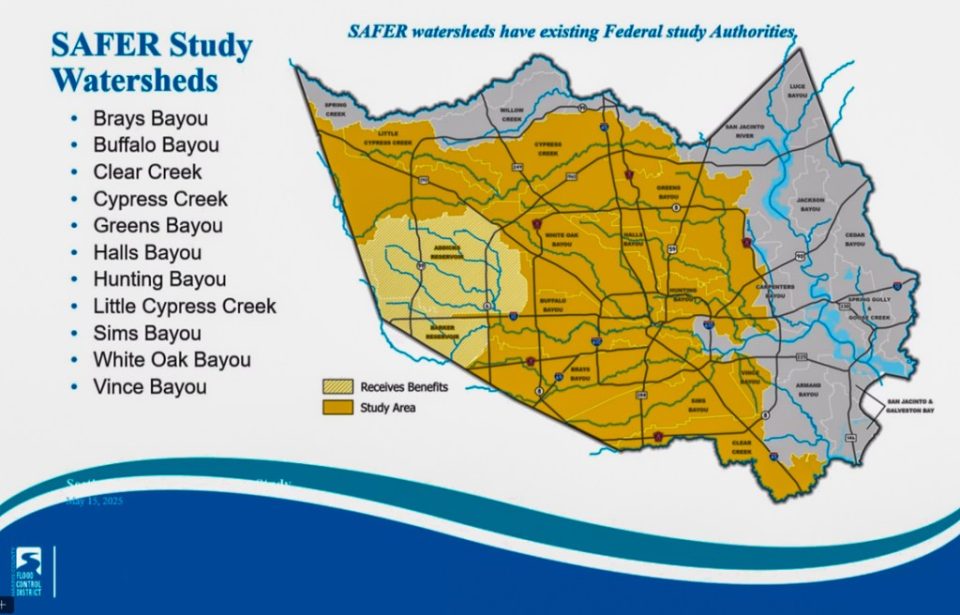
On May 31, 2026, the Harris County Flood Control District (HCFCD) announced that its SAFER study has progressed to Phase 2 of a five-phase initiative. SAFER, which stands for Solutions for Advancing Floodplain Evaluation and Resilience, is a strategic planning effort aimed at enhancing Harris County’s resilience to future flooding events. The study seeks to develop large-scale flood-risk reduction strategies eligible for federal funding, reflective of local priorities, and considerate of future regional growth conditions.
In Phase 1, HCFCD outlined the study’s scope and screened preliminary alternatives. Phase 2 will focus on evaluating combinations of these alternatives to establish a tentative plan. The subsequent phases will involve drafting a feasibility report and environmental impact statement, submitting final documents to the Army Corps, and coordinating efforts for Congressional authorization.
The SAFER study covers 11 out of 23 watersheds in Harris County, representing about half of the area. Alternatives under consideration aim to enhance the flood-handling capabilities of main-stem bayous and upstream tributaries, integrating solutions across multiple watersheds. These include both traditional methods, like channel widening, and innovative approaches, such as tunnels.
The evaluation process in Phase 2 will address key questions regarding the alternatives. The full presentation, available for download, details various combinations being considered. The evaluation of alternatives is expected to conclude by the third quarter of 2026, with economic and hydrologic assessments of each option. The Army Corps is anticipated to be briefed on the tentative plan by the end of this year or early next year, with Phase 3 commencing in early 2027.
While the study promises comprehensive flood-mitigation solutions, it covers less than half of the county’s watersheds, excluding rapidly growing areas like the San Jacinto, Spring Creek, Luce Bayou, and Cedar Bayou. These omissions could complicate future floodplain preservation efforts. HCFCD selected the 11 watersheds based on existing federal interest, which positions them for potential federal approval and funding. However, it appears that previous federal activities, such as dredging in the San Jacinto, were not considered.
