

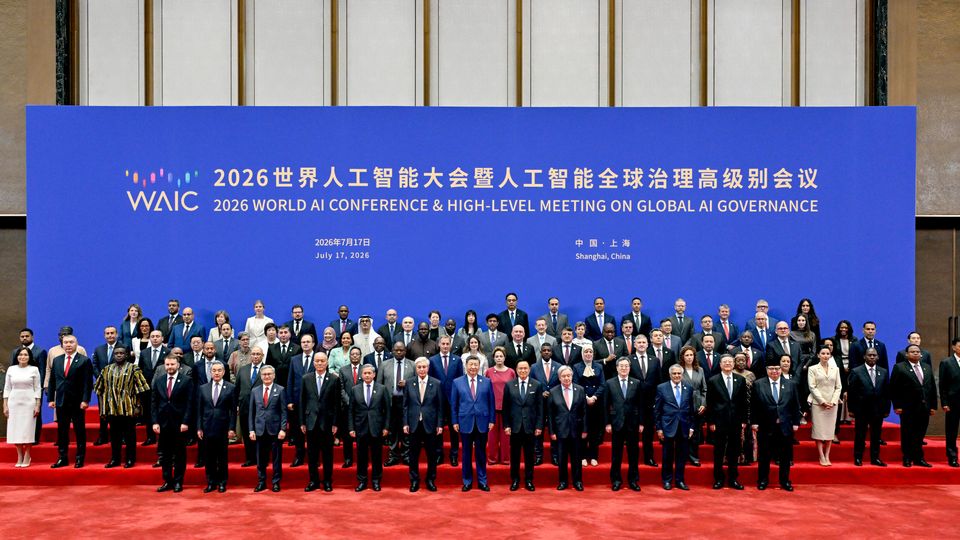
China aims to make artificial intelligence an affordable, open resource so “all sectors and companies can benefit,” the country’s leadership said at the World AI Conference in Shanghai. Reaffirmed by President Xi Jinping on July 17, that ambition is paired with concrete industrial application targets and measurable signs of economic growth.
IA FOR ALL: A POLITICAL AND INDUSTRIAL AMBITION
In his opening address to the World AI Conference and the Summit on Global Governance of AI on July 17 in Shanghai, Xi Jinping framed AI as “for the positive, for the good, and for humanity,” urging coordinated progress based on international cooperation. “AI development should not be a solo performance by one country, but a symphony of international cooperation,” he said.
NUMBERS INDICATING RAPID SCALE-UP
Officials point to significant economic indicators: the value of China’s core AI industries exceeded 1.2 trillion yuan (about $177 billion) last year, with annual growth above 20% for several years. In the first half of this year, industrial output in AI-related sectors increased by more than 30%. Data from the Ministry of Industry and Information Technology underscore the government’s push to anchor AI in the real economy.
PUSHING AI BEYOND CHATBOTS INTO THE “PHYSICAL ECONOMY”
China’s “AI Plus” strategy aims to convert algorithmic performance into concrete gains by embedding AI across manufacturing, finance, healthcare, energy, and public services. Huo Fupeng, director of the innovation-focused development center at the National Development and Reform Commission, says the scale of the Chinese market and the diversity of application scenarios are accelerating AI deployment across thousands of industries.
FROM SUPPLY CHAIN TO MASS PRODUCTION
Robotics illustrates this shift to industrial scale. PrimeBOT showcased a transformable robot that can switch between quadruped and humanoid configurations. Tian Hua, CEO of Swancor Advanced Materials and head of PrimeBOT, notes that while more than 1,000 companies can assemble a robot, few can produce 10,000 units with consistent quality and uniformity — an advantage he attributes to China’s industrial ecosystem for turning customized robots into mass-produced consumer products.
OPENNESS AND COOPERATION AS GLOBAL LEVERS
International observers see China’s emphasis on openness as a driver of global benefits. Alex Zhavoronkov, founder of an AI company focused on drug discovery, believes China’s approach and policies that promote open-source development will amplify positive spillovers across the sector.
