

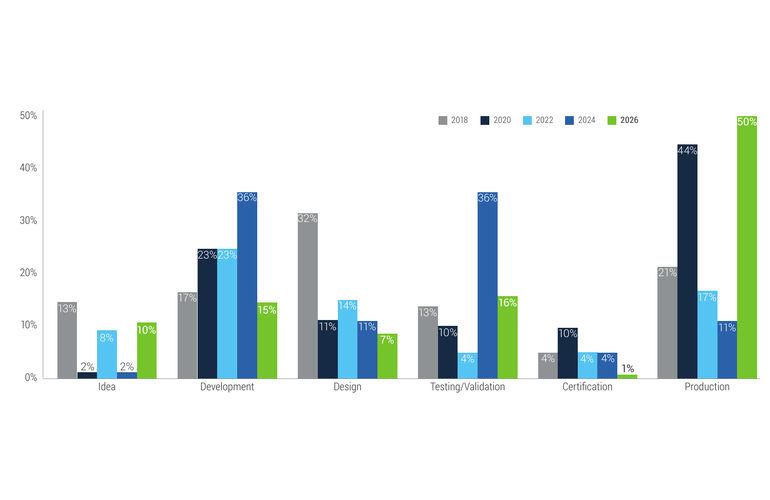
Jabil’s 2026 Digital Health Technology Trends survey found growing confidence in AI’s potential to transform healthcare even as companies report weaker internal readiness. Conducted by SIS International Research among 208 industry decision‑makers, the survey shows 70% of respondents now strongly agree that AI will transform healthcare, up from 51% in 2024, while only 20% strongly agree their companies have the internal talent to capture that opportunity, down from 49% in 2024. The report also found that half of respondents said their digital health solutions were in production—the highest share since the biennial research began in 2018.
The survey places those findings against concrete examples of digital health progress. A 2025 randomized trial in JAMA reported a three‑year pelvic recurrence rate of 1.6% for patients undergoing robotic surgery for middle or low rectal cancer, versus 4.0% after conventional laparoscopic surgery. In diabetes care, a 2025 randomized trial in NEJM found adults with insulin‑treated type 2 diabetes using an automated insulin delivery system saw HbA1c fall 0.9 percentage points over 13 weeks (versus 0.3 points with usual insulin regimens and continuous glucose monitoring), and time in range increase from 48% to 64%.
Digital health products move from development to production
Respondents reported a marked shift from development toward production: the share reporting technologies in production rose from 11% in 2024 to 50% in 2026. At the same time, development cycles are lengthening, with 58% of respondents saying it now takes at least two years to develop and launch a product, up from 42% in 2024.
Integration with healthcare ecosystems emerges as top challenge
As more products reach the market, integration with broader healthcare systems has become the survey’s most‑cited challenge: 73% of respondents selected it when asked about development hurdles. Jabil’s senior director of engineering services, Erich W. Stein, said the results suggest wider adoption across end markets and described a central technical problem: “And the challenge that the market is facing is how do all of those devices communicate together, and how does the data set come in from all of those devices?” He added, “How is that analyzed and interpreted to really, I guess, assess a holistic picture of health? And that is very, very difficult.” Stein warned that reconciling different communication protocols, security measures and architectures “isn’t going to be solved in the next couple years” and estimated “that’s probably going to take five years plus.”
The survey identified specific priorities for that work: 68% of respondents selected healthcare data exchange standards such as HL7 FHIR and DICOM, 62% selected cybersecurity frameworks, and 56% selected integration with electronic health records.
Product mix shifts as early categories mature
The mix of products under development has shifted since 2024. The share developing or planning diagnostic equipment fell from 59% to 34%, and diabetes management declined from 36% to 16%, while surgical robotics rose from 9% to 18%. Patient monitoring and chronic condition management remained the most frequently selected categories at 49% and 45%, respectively. Stein attributed declines in diagnostics and diabetes management to earlier products reaching the market and a survey question that focused on what companies “develop or plan to develop,” not what they produce.
AI optimism clashes with long development timelines
AI’s rapid evolution is heightening planning challenges for medical device companies. Jabil’s vice president of medical technology, Shane Smith, linked part of the uncertainty to extended development timelines: with some products taking three or four years to reach the market as AI advances rapidly, “Trying to predict where AI is going to be at that point in time is an impossible task.”
Payers, adherence and wearable ‘set it and forget it’ devices
Respondents expect payer concerns about costs to increase demand for digital tools that support adherence and demonstrate treatment efficacy: 72% said they expect such payer concerns to expand demand, up from 28% in 2024. Stein described a growing emphasis on wearable solutions that collect data automatically over days or weeks—so‑called “set it and forget it” devices—reducing the need for patients to take daily measurements and enabling more reliable longitudinal data collection.
The survey’s participant profile changed notably: the share of respondents from the Americas fell from 81% in 2024 to 51% in 2026, while Europe, the Middle East and Africa rose from 18% to 33% and Asia Pacific from 1% to 14%. Roles in marketing, sales and business development increased from 6% of respondents to 23%.
Updated Oct. 23, 2026, with the respondent profile from Jabil’s revised report.
