

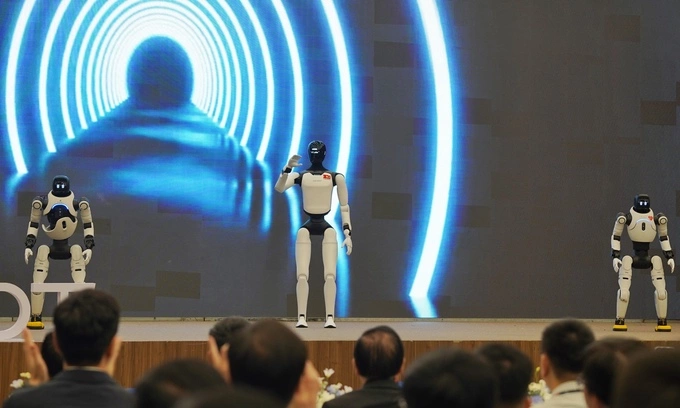
Humanoid robots are appearing more often across Vietnam but remain largely confined to exhibitions and research labs and currently offer little help in boosting labor productivity, speakers said at the Vietnam Embodied AI Conference on Oct. 2, 2026 in Hanoi.
Humanoid robots: phases and current status in Vietnam
Lam Thien, a distributor for Chinese robotics maker AgiBot, outlined three market phases at the conference: an initial phase focused on demonstrations, education and academic research; a second phase in which robots are integrated into industrial manufacturing and warehouse logistics and that delivers the steepest growth; and a final phase in which mature technology reaches the home. By that metric, he said, Vietnam remains squarely in the first phase, where humanoids mainly showcase basic motor skills such as walking, dancing or performing martial arts and serve primarily as educational and research tools.
Those controlled settings impose far lower technical demands than deploying robots on active assembly lines, in busy warehouses or inside domestic living spaces, Lam added. He noted that buyers look past raw hardware: “Customers don’t buy robots; they buy results.” Clients, he said, care far less about technical specifications such as degrees of freedom, sensor suites or camera resolutions than about whether a machine can cut costs or raise output.
Market figures and industry outlook
Citing Counterpoint Research, Lam reported that global humanoid robot shipments surged by nearly 300% in the first half of 2026 to 22,000 units. The top five manufacturers, all based in China, hold 86% of the market, with AgiBot leading at a 43.1% share and Unitree at 31%.
Abel Deng, who oversees AgiBot’s Middle East and Asia-Pacific regions, said artificial intelligence is making a fundamental leap from digital screens into the physical world. He identified three catalysts for the industry: large language models that improve a machine’s understanding of human intent and surroundings; sturdier physical bodies built with advanced materials, better batteries, reliable actuators and precision hardware; and operational data. As more robots enter service, they gather real-world data that refines AI models and enables broader use cases.
Deng described two development tracks: one focused on refining human-like movement to deliver immediate value for research, education and entertainment, and another aimed at training machines to “work like humans” in factories, logistics hubs and other industrial settings.
Do Tien Thinh, deputy director of the National Innovation Center, said embodied AI is not entirely new to Vietnam: hospitals used robots during the Covid-19 pandemic and several local enterprises have run trials. He acknowledged that hardware lags significantly behind software rollouts such as conversational chatbots and large language model platforms, but said Vietnam has established a relatively comprehensive policy framework for AI and robotics and that the domestic market holds strong potential.
Thinh identified specific sectors where humanoid machines could boost labor productivity, including electronics manufacturing, garment production, food processing, seaports, logistics and agriculture. He also said Vietnamese firms could find roles in the global supply chain by producing mechanical components, precision tooling and specialized semiconductors and by supplying integrated software, training datasets and maintenance services. That technological foundation, he added, could help attract high-value foreign direct investment and anchor smart manufacturing facilities and research hubs. Thinh noted Vietnam’s growing pool of tech and AI talent as a solid base to foster the emerging ecosystem.
