

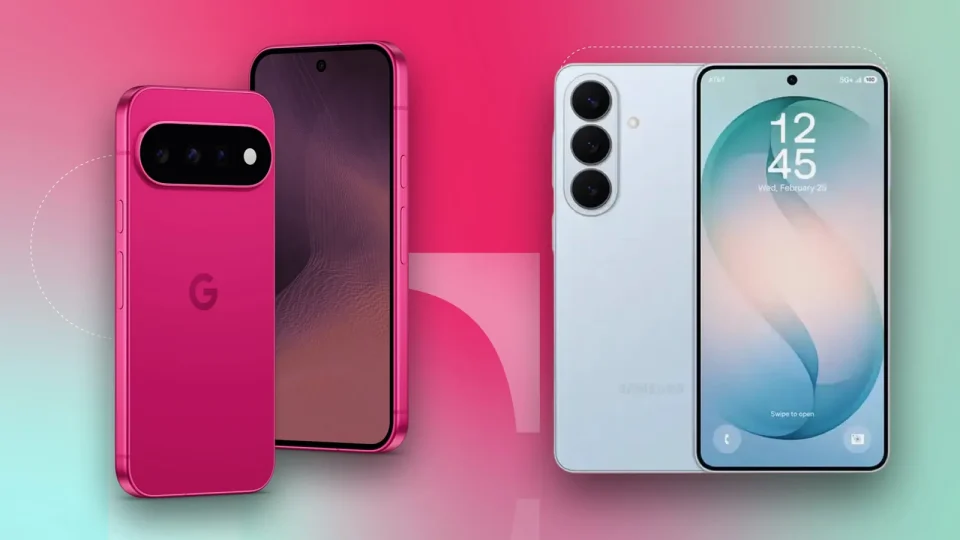
I compared the Google Pixel 11 and the Samsung Galaxy S26 closely, and for six practical reasons I would pick the Pixel 11 this year: a larger battery, built-in Qi2 magnetic wireless charging with faster speeds, a more meaningful camera upgrade, a new Tensor G6 chipset built on 2nm, faster access to Android updates, and a more distinctive design.
A small reader poll reflected mixed interest: out of 459 votes, 46% chose Google Pixel 11, 30% chose Samsung Galaxy S26, 14% were waiting for reviews, and 9% picked none of these.
Bigger battery that should last longer
The Galaxy S26 ships with a 4,300mAh battery, which has been described as small for a 2026 Android flagship and sufficient for a day of normal use but likely to run short under heavy gaming, navigation, or extended camera use. The Pixel 11, by contrast, packs a 4,840mAh battery. That 4,840mAh cell is larger than the battery in the Galaxy S26 Plus, despite the Pixel 11 being closer in overall and screen size to the regular Galaxy S26. Samsung has increased capacity on its Galaxy Z Fold series, but that treatment has not been applied to the Galaxy S series.
Pixel 11 wireless charging: built-in Qi2 magnets and faster speeds
The Pixel 11 continues Google’s inclusion of Qi2 magnets built directly into the phone, as seen on the Pixel 10 series, so magnetic Qi2 accessories attach without a third-party case. The Pixel 11 supports Qi 2.2 and can charge wirelessly at up to 25W. The Galaxy S26 is only Qi2 Ready: it supports the underlying Qi2 technology but does not include the Magnetic Power Profile, and it tops out at 15W wireless charging. That means magnetic Qi2 accessories will require a compatible Samsung or third‑party case on the S26.
More meaningful camera upgrades on Pixel 11
Samsung increased the Galaxy S26’s price by $100 while retaining the same camera hardware as the Galaxy S25. The Pixel 11 also costs $100 more than its predecessor, but Google introduced a new 48MP primary sensor the company says can capture up to 56% more light than before. The 10.8MP telephoto and 13MP ultrawide remain unchanged, but the Pixel 11’s telephoto now supports up to 30x maximum zoom (previously 20x on the Pixel 10) and offers 5x optical zoom out of the box. The Galaxy S26’s telephoto camera tops out at 3x. Camera performance still requires full testing, but on hardware alone Google made the more visible upgrades this year.
Tensor G6 on 2nm could address past Pixel issues
The Pixel 11 uses Google’s new Tensor G6, built on TSMC’s 2nm process. The Galaxy S26 uses a Snapdragon 8 Elite Gen 5 built on a 3nm process. While the Pixel 11 is not expected to necessarily beat the Galaxy S26 in raw performance, the move to 2nm raises the possibility that some long-standing complaints about Pixel devices—specifically overheating and poor efficiency—may be improved. Full benchmarking and direct comparisons are pending.
Nobody beats Pixel on early Android updates
Google’s Pixels typically receive new Android versions and Feature Drops before other manufacturers. Samsung has improved its update policy and accelerated major Android releases for Galaxy devices, but it still generally trails Google. If getting the latest Android features as soon as they arrive is a priority, the Pixel 11 remains the more immediate option.
Design and personality
The Galaxy S26’s design is described as lightweight and slim but increasingly hard to distinguish from previous Galaxy S generations. The Pixel lineup maintains a more recognizable identity—particularly the distinctive camera visor—making the Pixel 11 easier to spot and, for some buyers, more appealing for its personality.
Overall, I would pick the Google Pixel 11 over the Samsung Galaxy S26 for the bigger battery, built‑in Qi2 support with faster wireless charging, the upgraded primary sensor and stronger telephoto hardware, the new Tensor G6 built on 2nm, faster access to Android updates, and a more distinctive design. That said, the Galaxy S26 is not presented as a bad phone: for a more feature‑rich Android experience, Samsung’s One UI and the proven Snapdragon performance may still make the Galaxy S26 the better choice for some users.
