

Ukraine’s unmanned ecosystem has moved beyond a single “drone story” to a full‑stack race across air, ground and sea — and across comms, sensors, electronic warfare, manufacturing and training loops. Observers map a shifting baseline: what has become standard practice, what is already outdated, and what is quietly becoming the new norm for 2026.
Unmanned systems: EW resilience becomes the real spec sheet
Survivability in contested spectrum has overtaken raw range and camera specifications as the defining attribute of useful systems. The current trend emphasizes multi‑band control links and smarter frequency management, improved shielding and cleaner onboard electronics to reduce self‑inflicted interference, and tighter integration between communications, navigation and mission logic so systems degrade gracefully rather than simply dropping. The practical takeaway in 2026 is straightforward: platforms that cannot operate in noisy electromagnetic environments are effective only in fair weather.
Navigation without perfect GPS is now required
When navigation is contested, redundancy matters. Momentum is building behind improved inertial navigation and dead reckoning, terrain‑aware routing and map‑matching concepts, and more robust procedures for “lost link” behavior and safe fallback modes. Operators increasingly value platforms that return reliably over those that post high numbers only in ideal conditions.
Autonomy shifts to specific, useful features
Autonomy has moved from grand promises to small, practical capabilities that lower operator workload. Expect more automated stabilization and hands‑off hover behaviors, onboard detection that flags anomalies so humans are not forced to watch raw video continuously, and route assistance and obstacle handling tuned for real terrain instead of demonstration fields. The objective is not a drone that “thinks like a human” but systems that keep working when operators are tired, stressed or multitasking.
Mass production designed for rapid iteration
The operational tempo in Ukraine has produced a build‑test‑lose‑learn‑update cycle. Manufacturing in 2026 is oriented toward iteration as much as volume: modular frames and standardized mounts for quick part swaps, supply chains prioritizing availability over perfect components, and QA processes calibrated to field realities rather than only lab checks.
Payload modularity and mission kits become normal
Single‑role airframes are a luxury. The trend is toward platforms that shift roles with minimal rework: swappable EO/IR sensor packages, modular communications relays instead of hardwired configurations, and specialized payload options changed without rebuilding the platform. This modularity helps the same base design support different tasks across units and environments.
Counter‑UAS becomes layered and realistic
Counter‑drone thinking in 2026 is less about a single perfect tool and more about layered detection and layered response. Mixed detection methods (RF, visual, acoustic and radar where practical), an emphasis on early warning rather than hero interception, and site hardening plus movement discipline to reduce exposure are gaining traction.
Swarm‑ish coordination, not Hollywood swarms
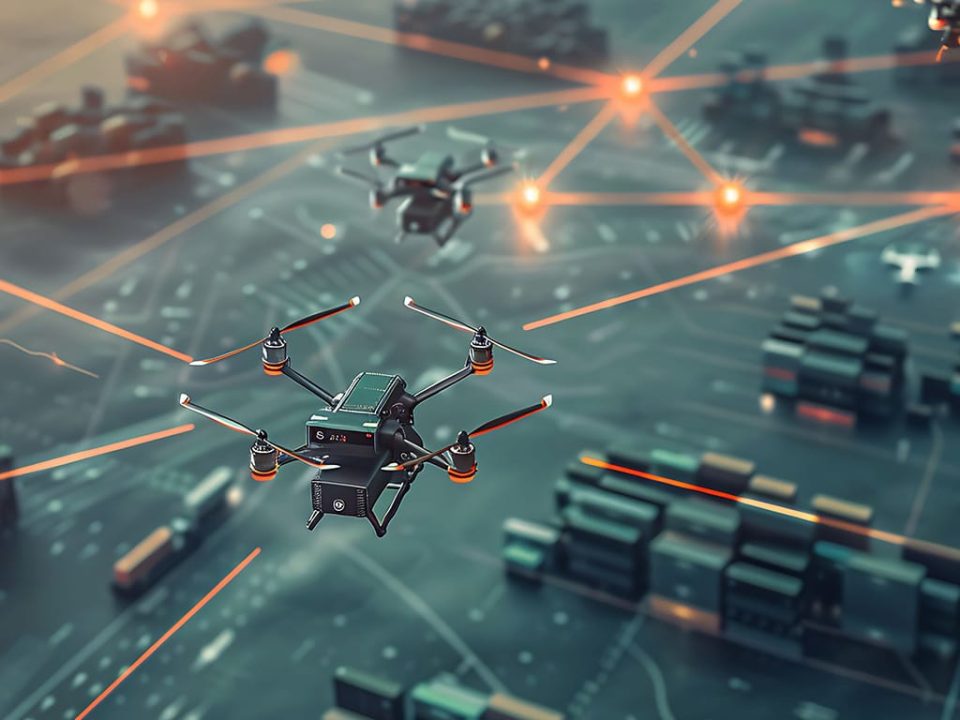
What is called swarming in practice looks more like coordination and task distribution than synchronized, cinematic clouds. Multiple low‑cost platforms work as loose teams with defined roles, relay behaviors extend observation and coverage, and semi‑automated handoffs allow one system to take over when another exits. The result is resilience through redundancy: losing one unit does not defeat the mission.
Ground and maritime unmanned systems become practical tools
Beyond aerial platforms, UGVs and USVs are moving from niche demonstrations to practical applications where they reduce risk and workload: logistics support and resupply under threat, reconnaissance in hazardous areas, and specialized operations where human exposure is the primary cost. Progress here is steady rather than flashy, constrained by terrain, maintenance and communications realities.
Data becomes the fuel; video alone is not enough
Hundreds of feeds are chaos without structure. The trend is toward converting raw observation into usable decision support: automated tagging and fast retrieval of events, better fusion between aerial observation and other sensors, and smarter workflows for sharing data across teams without overwhelming them. The next operational advantage may lie less in seeing more and more in turning seeing into timely action.
Overall, unmanned systems in Ukraine are trending toward a new baseline in 2026: cheaper, more replaceable, more adaptable and more integrated into how units plan and move. The emphasis has shifted from single “wonder drones” to systems that survive contested conditions, scale through production and improve through constant iteration. Technology is only half the picture: training, doctrine and operational discipline remain the other half, and platforms that fit human realities — limited time, limited bandwidth and tools that work when the day goes badly — are the ones likely to draw attention.
